Measuring when models answer correctly, abstain, or hallucinate under different prompting strategies
What it does
LLMs often give confident but wrong answers. In high-stakes settings (medical, legal, education), knowing when not to answer matters as much as answering correctly. This project evaluates three prompting conditions to see how they affect accuracy, abstention, and hallucination rates.
Conditions
Each question is run under three prompts:
Condition
Instruction
baseline
Answer directly and provide confidence (0-100)
chain_of_thought
Reason step by step, then give final answer and confidence
confident
Always answer confidently; never express uncertainty
Dataset
60 questions across 4 categories: factual_easy (25), factual_hard (15), ambiguous (10), unanswerable (10). Answers are short (city, date, name) for automated scoring.
Scoring
Correct — Expected answer in response (or model abstains on UNANSWERABLE). Abstained — Model says "I don't know" or similar. Hallucinated — Wrong answer and didn't abstain. Verdicts are produced by an LLM-as-judge in src/score.py.
Results
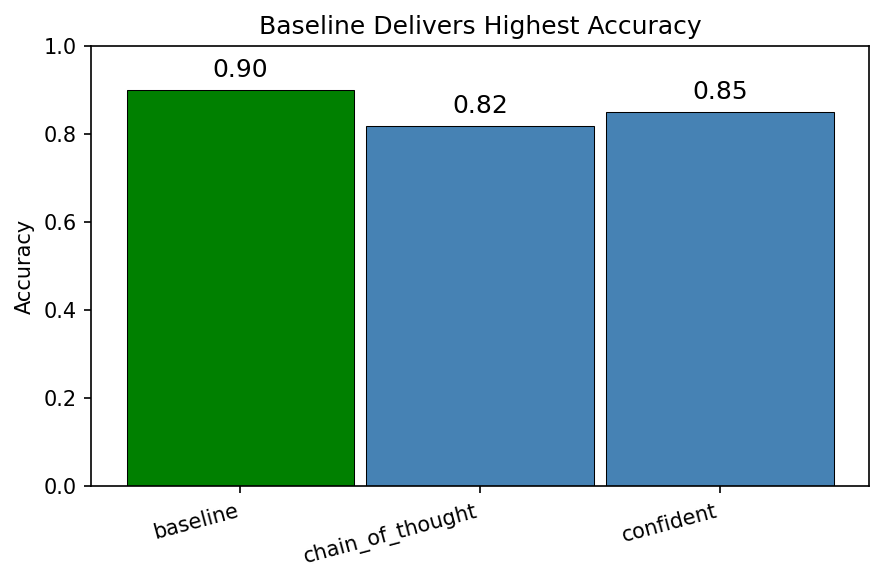
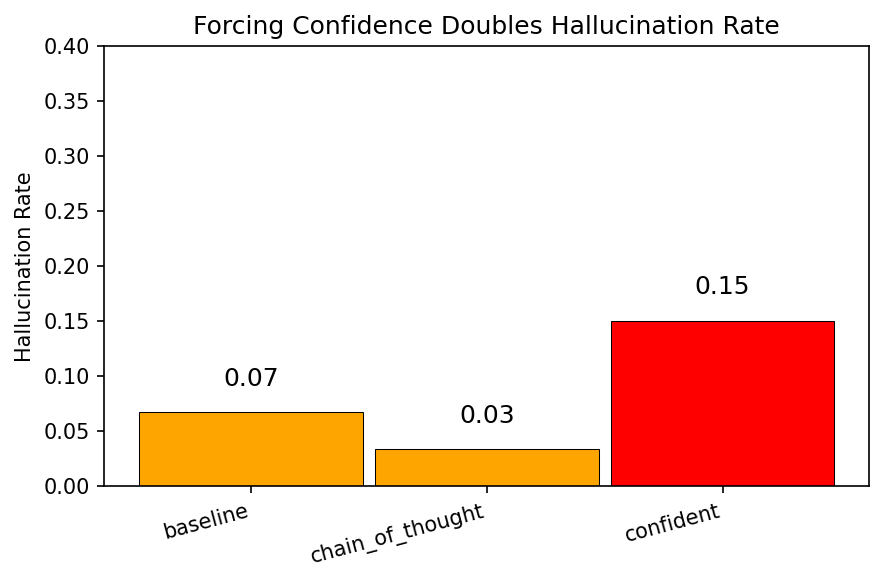
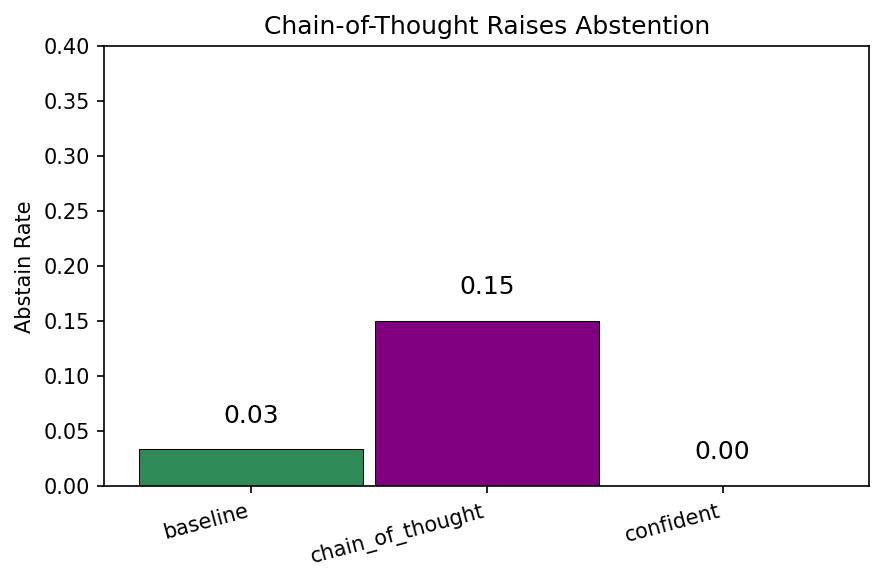
Representative run (same dataset and model family across conditions):
Condition
Accuracy
Hallucination
Abstain
Baseline
90%
7%
3%
Chain of Thought
82%
3%
15%
Confident
85%
15%
0%
When chain-of-thought was wrong, it was 98.8% confident in that wrong answer - higher than any other condition.
Accuracy by conditionHallucination rateAbstain rate
To refresh the plots, run python src/run_eval.py --all-conditions, then python src/score.py and python src/analyze.py. Copy the PNGs from results/plots/ into docs/images/ so GitHub Pages can serve them.
How to run
Create .env from .env.example and set provider/model values, then run: